

Virtual Fitness and Indoor Rowing:
How Virtual Reality Rowing Can Help You Train More Consistently
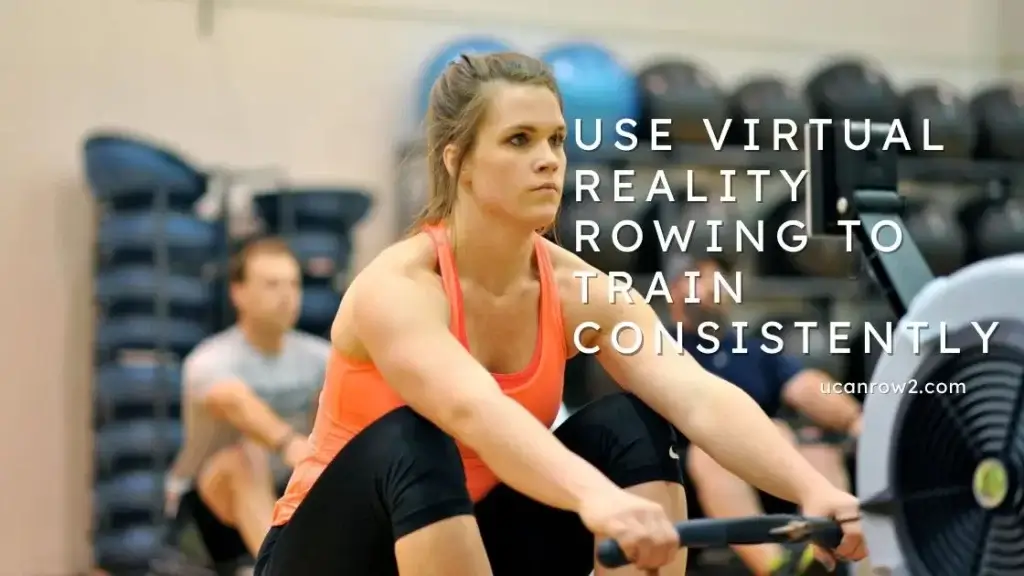
Have you ever bargained with yourself mid-row?
“Just 15 more minutes and I can quit.”
“I’ll do 20 minutes today and make up the rest tomorrow.”
“If I can just get to 5,000 meters, that’s good enough.”
Most rowers don’t stop training because rowing doesn’t work.
They stop because indoor rowing demands serious mental stamina: long stretches of steady work, minimal feedback, and a lot of time alone with your thoughts and a monitor displaying numbers.
If this sounds familiar, you’re not alone. And the solution isn’t more willpower or tougher training plans.
It’s changing the experience itself.
Virtual fitness and virtual reality rowing don’t change the work you do. They change the experience of doing it, and that’s a more meaningful distinction than you might think.
What “Virtual Fitness” Actually Means for Rowers
When we talk about virtual fitness, we’re not talking about gimmicks or shortcuts. We mean exercise environments that go beyond a static screen and basic metrics.
Think immersive visuals, optional social presence, structured routes or environments, and sometimes shared or synchronous sessions with other rowers.
Needless to say, virtual fitness platforms don’t do your workouts for you.
You still produce watts. You still manage technique. You still work just as hard.
What changes is the mental load you bear during the session. For solo rowers especially, that shift matters more than you might think.
My Experience
Let me be upfront: EXR asked me to write this article and compensated me for my time. The opinions here are entirely my own, though, and I only write about things I’d actually recommend to my coaching clients or use myself.
I’ll be honest. When I first tried virtual rowing, I was skeptical. I’ve been rowing for years. I know what works. Why would I need a virtual environment?
But after two weeks of testing it, I noticed something interesting: I wasn’t negotiating with myself anymore about whether to start. I just…started.
I found myself:
- Skipping fewer sessions
- Starting workouts faster without the usual mental prep time
- Feeling like time passed more quickly during steady rows
- Actually looking forward to getting on the erg
In short, the EXR app removed a few of the mental barriers that can make erg sessions feel like effort before they even start.
So if you’ve been struggling with consistency lately, keep reading.
Research Review: Why virtual fitness can make you actually want to row
This isn’t about motivation in the vague sense. It’s about how workouts feel while you’re doing them, and that’s one of the strongest predictors of whether you’ll do them again.
It’s common in rowing circles to refer to workouts on the machine as being torture, as if that should always be the goal.
I talk all the time about how there is value in being willing to push yourself to an intensity that really challenges you but, especially for those who struggle to work out at all, there might be even more value in enjoying the ride.
1) Enjoyment and immersion reduce perceived effort
A 2025 systematic review of virtual fitness and active video games in older adults found consistent increases in enjoyment and satisfaction — even when participants were doing the same physical work as they otherwise would.
Key idea: If a workout feels better while it’s happening, you are more likely to repeat it. That’s the fundamental behavior change mechanism here.
It’s common in rowing circles to refer to workouts on the machine as being torture, as if that should always be the goal.
2) Immersive rowing environments can support performance and enjoyment
In a study published in Psychology of Sport and Exercise, researchers had rowers train in a virtual reality environment and found both performance and enjoyment increased, especially when they had a virtual teammate with them.
Although the study sample was modest and skewed young, this aligns with broader psychology research on social facilitation — the idea that the presence of others (even virtual) can help people work harder and feel better when they’re doing it.
For rowers missing teammates or group energy, this can be surprisingly impactful.
3) Social presence supports motivation and physical activity
A study published in Physical Activity and Health looked at users on virtual fitness platforms and found that awareness of social presence — even asynchronous or minimal social visibility — was associated with higher motivation and self-reported physical activity levels.
Note: This doesn’t mean you must train with people to improve, but it does mean that environments where you feel connected — even lightly — can make training more engaging.
If you’ve been training solo for years, this might be the missing piece you didn’t know you needed.
4) Older adults respond well to interactive, immersive exercise
The same 2025 JMIR Aging review I mentioned earlier demonstrates that older adults (a category that, academically speaking, overlaps significantly with midlife rowers) tend to report higher satisfaction with active video game formats than they expect, even when the physical demands are equivalent to traditional exercise.
This challenges the stereotype that immersive or virtual exercise is “only for younger people.” In fact, many midlife and older adults prefer environments that reduce monotony and provide context or feedback.
This matters if you’re in your 40s, 50s, or beyond. You’re not training because you have to—you’re training because you choose to. And when time is limited, workouts that feel efficient, worthwhile, and engaging become more valuable.
Why Rowers Over 40 Are Crushing It With Virtual Reality Training
If you’re in your 40s or 50s (or beyond), you’re probably not training because you must. You’re training because you choose to—and when time is limited, workouts that feel efficient, worthwhile, and engaging become more valuable.
Virtual reality rowing doesn’t change the work. It changes the experience of executing that work—and that’s often the unsung barrier to consistency.
Here’s what I’ve noticed with my coaching clients in this age group:
- The issue typically isn’t fitness. They know how to work hard. They’ve been athletes for years.
- The issue is sustainability. Finding ways to stay consistent when life is full, when recovery takes longer, and when boring workouts feel even more boring than they used to.
Virtual fitness addresses that specific problem without requiring you to work harder or add more training volume. You just show up more reliably because the experience is better.
What virtual fitness doesn’t do (and why the distinction matters)
Let’s be clear:
Virtual fitness does not:
- replace sound programming
- override recovery deficits
- magically generate motivation from thin air
But it can:
- make starting easier
- reduce perceived boredom
- provide context and feedback that improve enjoyment
- help workouts feel shorter mentally without reducing effectiveness
FAQ: Virtual Reality Rowing & Virtual Fitness
Virtual rowing workout plans for beginners — do they work?
Beginner plans that emphasize consistency and simple progression work best — whether they are delivered via a screen or a paper training log.
What makes virtual rowing environments helpful for beginners is that they:
- reduce intimidation
- provide immediate feedback
- give structure that doesn’t require constant self-management
The workouts aren’t easier. They’re just framed in a way that makes it easier to start and finish them.
Top-rated apps for virtual rowing training — what should rowers look for?
Rather than ranking individual apps, seasoned rowers should look at:
- how closely the app integrates with rowing erg data
- whether it supports a variety of training types (steady, threshold, intervals)
- options for community or shared experiences
- low setup friction (fast pairing, seamless login, minimal waiting)
The best choice is one that makes you row more often without adding hassle.
For me, EXR does that in spades.
A simple way to try virtual fitness without overthinking it
Here’s a low-commitment experiment rowers can use to test whether virtual environments help:
Two-week trial protocol
- Keep your usual weekly volume
- Aim for 3–4 sessions per week
- Include:
- one steady state session
- one interval piece
- one optional “just row” session
After two weeks, ask yourself:
- Did I show up more often?
- Did starting feel easier mentally?
- Did steady work feel less monotonous?
If the answer is “yes,” the environment may be helping.
If you’d like to try EXR, and get 15 percent off on your subscription after the 2-week trial period, sign up here and use the code UCR2 when you enter your payment method.
The bottom line
Virtual fitness doesn’t change rowing physiology. It changes the experience of the training environment — and that experience matters.
Same erg.
Same work.
Different context.
For rowers who struggle more with consistency than capacity, that difference can be decisive.
Have you tried virtual rowing?
Did this post get your gears turning? What questions – or comments – do you have about virtual rowing or EXR specifically? Drop them in the comments, I’m all ears!